The How Redox Modulation May Help Prevent Age-Related Decline
Oxidative Stress and Inflammaging
DOI:
https://doi.org/10.62368/pn.v5i1.71Keywords:
phytonutrients,, antioxidants, oxidative stress, inflammaging, mitochondria, mitophagyAbstract
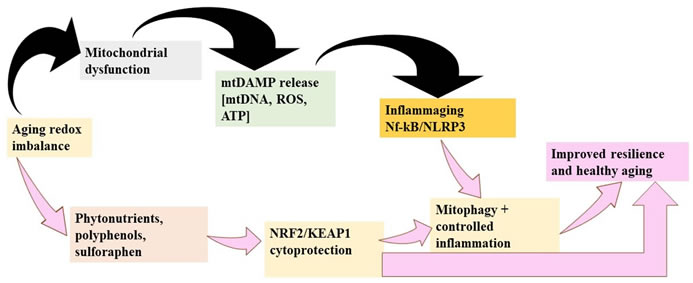
Aging is associated with progressive disruption of redox homeostasis, mitochondrial quality control, immune regulation, and stress-response signaling, all of which contribute to functional decline. Reactive oxygen species (ROS) are now understood not only as damaging oxidants but also as essential signaling molecules involved in hormesis, innate immunity, and cellular adaptation. This dual role helps explain why conventional antioxidant supplementation has produced inconsistent outcomes. The aim of this study was to review how redox modulation and antioxidant-related mechanisms may help prevent or delay age-related decline, with particular focus on mitochondrial dysfunction, mitochondrial danger-associated molecular patterns, NRF2/KEAP1 signaling, NF-κB activation, NLRP3 inflammasome pathways, and mitophagy. Current evidence suggests that antioxidants are most effective in aging prevention when they act as modulators of redox-sensitive signaling pathways rather than as simple radical scavengers. Key pathways highlighted in this review include the NRF2/KEAP1 axis, NF-κB signaling, the NLRP3 inflammasome, and mtDNA-triggered innate immune pathways such as TLR9 and cGAS–STING. With aging, mitochondrial dysfunction increases electron leak and ROS generation, while impaired mitophagy promotes the accumulation of damaged mitochondria and release of mitochondrial danger-associated molecular patterns, including mtDNA, cardiolipin, ATP, N-formyl peptides, and mitochondrial ROS. These signals activate inflammatory cascades, leading to increased production of IL-6, TNF-α, IL-1β, IL-18, caspase-1 activation, and type I interferon responses. Simultaneously, age-related decline in NRF2 responsiveness weakens endogenous defense systems, including HMOX1, NQO1, GCLC, GCLM, and GPX4. Dietary antioxidants and bioactive compounds such as polyphenols and sulforaphane may help preserve healthy aging by activating NRF2-dependent cytoprotective programs, attenuating chronic NF-κB activation, constraining NLRP3 inflammasome signaling, reducing mitochondrial damage, and improving mitophagy. A pathway-focused, food-first antioxidant strategy may therefore offer greater benefit for delaying age-related decline than untargeted high-dose supplementation.